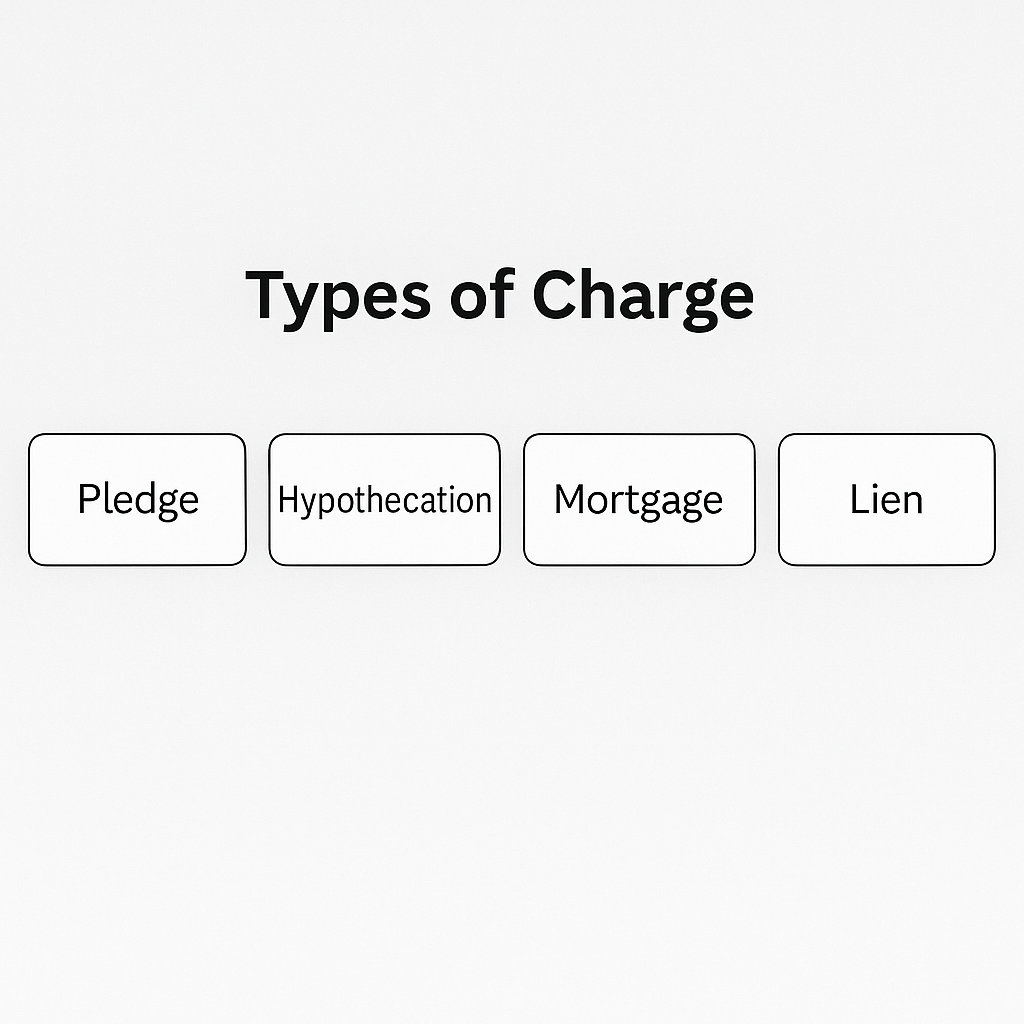
Types of Charges under Companies Act, 2013
Under Section 2(16) of the Companies Act, 2013, a charge is defined as “an interest or lien created on the property or assets of a company or any of its undertakings or both as security, and includes a mortgage.” Charges are an essential concept in corporate finance as they provide security to creditors when companies borrow money.
Why are Charges Important?
- They help companies raise secured loans at better interest rates.
- They protect the rights of creditors by offering collateral.
- They are legally enforceable if properly registered with the Registrar of Companies (ROC).
- They impact company valuation, borrowing capacity, and risk analysis.
Types of Charges
Charges can be classified based on their nature, operation, and the type of asset involved. Below are the key types:
1. Fixed Charge
A fixed charge is created on a specific, identifiable, and immovable asset of the company such as land, building, or machinery.
- The asset cannot be sold or transferred without the lender’s consent.
- The charge remains in force until the loan is fully repaid.
2. Floating Charge
A floating charge is created over a category of changing assets like stock, inventory, or receivables. It “floats” until it crystallizes.
- The company can deal with the assets in the normal course of business.
- Upon default, liquidation, or as per contract, the floating charge crystallizes into a fixed charge.
3. Pari Passu Charge
This type of charge gives equal rights to multiple lenders over the same asset. All charge holders share the proceeds equally in case of enforcement.
- Common in syndicated or consortium lending.
- Useful for large infrastructure and capital-intensive companies.
4. Consortium Charge
When a group of lenders jointly finance a company, a consortium charge is created. Usually, one lead bank manages the account on behalf of others.
- Efficient coordination and monitoring of large loans.
- Each lender may hold separate or joint charges.
5. Equitable Mortgage (or Mortgage by Deposit of Title Deeds)
In this type, the borrower deposits title deeds with the lender as security without formal registration under the Transfer of Property Act. However, it must be registered with ROC.
Registration of Charges
- Charges must be registered with the ROC within 30 days of creation using Form CHG-1 or CHG-9 (for debentures).
- Unregistered charges are not valid against a liquidator or other creditors.
- Modifications and satisfaction of charge must also be filed.
- ROC issues a Certificate of Registration of Charge (Form CHG-2).
Modification and Satisfaction of Charges
If a charge is modified (e.g., loan amount increased), it must be re-registered. Once the loan is repaid, the satisfaction of charge must be filed within 30 days using Form CHG-4.
Legal Consequences of Non-Registration
- The charge becomes void against liquidators or other creditors.
- Penalties can be imposed on the company and its officers.
- Loss of security interest for the lender.
Difference Between Fixed and Floating Charges
| Aspect | Fixed Charge | Floating Charge |
|---|---|---|
| Assets Covered | Specific assets (e.g., land, machinery) | Changing assets (e.g., stock, receivables) |
| Control | Company cannot sell asset freely | Company can use assets until crystallization |
| Crystallization | Not applicable | Occurs on default, liquidation, etc. |
Conclusion
Understanding the types of charges under the Companies Act, 2013 is crucial for both companies and lenders. Charges protect creditors and help companies access capital, but they also require strict legal compliance. Proper registration, documentation, and classification of charges ensure smooth financing and risk management for all stakeholders.