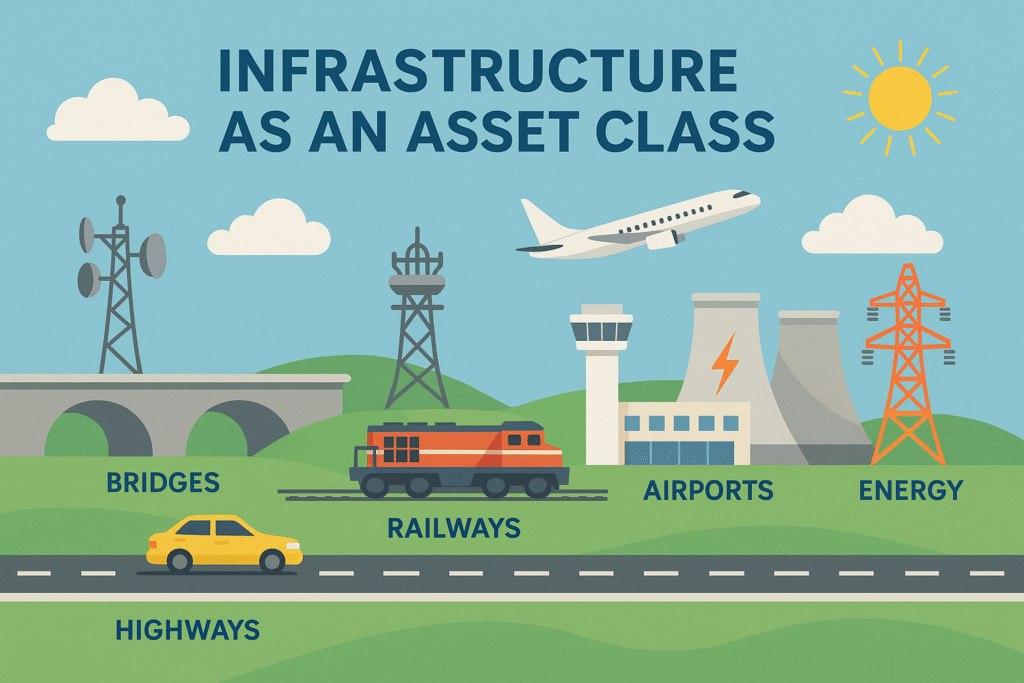
When we think of investing, our minds often jump to stocks, mutual funds, or gold. But there’s a lesser-known and often underappreciated category: infrastructure.
Infrastructure assets include long-term physical systems and public utilities such as:
Roads, highways, bridges
Airports, railways, metros
Power plants (thermal, hydro, solar)
Ports, logistics hubs, SEZs
Telecom towers, fiber networks
Water supply, waste treatment plants
These are high-cost, long-gestation assets designed to provide essential services to society. In financial terms, they offer predictable, inflation-linked, long-duration cash flows — making them ideal for pension funds, insurance companies, sovereign funds, and long-term retail investors.
Why Infrastructure Is Treated as a Separate Investment Class:
| Feature | Infrastructure | Equity | Bonds |
|---|---|---|---|
| Returns | Moderate but stable | High but volatile | Low and fixed |
| Risk | Project-level, regulatory | Market-based | Interest-rate based |
| Liquidity | Low (unlisted/illiquid assets) | High | Moderate |
| Duration | 10–30 years | Short to medium | Short to medium |
Real-World Example: How a Highway Becomes an Investment:
Let’s take a toll highway project under the PPP (Public-Private Partnership) model.
-
A private company (say, IRB Infra) builds the road
-
It gets the right to collect tolls for 20 years
-
Revenue depends on traffic volume (risk)
-
Loans fund 70% of the cost, equity covers 30%
-
Investors earn returns from toll collections after repaying debt
This project has:
-
Project IRR (for the whole project)
-
Equity IRR (just for investor’s portion)
-
DSCR (can toll revenue cover debt?)
-
Concession agreements and government guarantee
Such structures are common in roads, airports, metros, ports, even hospitals — and analyzing them requires project finance skills, not just stock-picking.
Tools and Metrics That Matter in Infra Finance:
Understanding infra as an asset class means learning to evaluate it differently.
| IRR: Measures total project Returns accros years |
| Equity IRR: Measures return on investor’s equity only |
| DSCR Can project cash flows cover debt repayments |
| Payback period How long till the investor gets money back |
| Viability Gap Funding (VGF) Govt support for socially important but financially weak projects |
Final Thought: Finance That Builds a Nation
When you invest in infrastructure, you’re not just earning returns — you’re funding progress.
Infra investing is long-term, tangible, and high-impact. Whether you’re analyzing a toll road IPO, calculating DSCR for a solar project, or just tracking infra sector stocks — you are participating in a story far bigger than the market. At Smart Niveshak, we believe infrastructure isn’t just an asset class — it’s a national priority with personal investment potential.