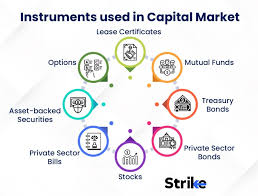
Capital market is a market for long-term debt and equity shares. In this market, the capital funds comprising of both equity, debt and hybrid instruments are issued and traded. Financial Instruments that are used for raising capital resources in the capital market are known as capital market instruments.
The capital market includes private placement sources of debt and equity as well as organized markets like stock exchanges.
In order to ensure that capital market work in an orderly manner, Securities and Exchange Board of India (SEBI) act as a watchdog to protect investors against market manipulation, unfair trading and fraud amongst others.
Types of Capital Market Instruments
1. Equity Shares
Equity shares represent ownership in a company and come with voting rights and a share in profits through dividends. Key characteristics include:
- Dividends depend on profits; in case of bankruptcy, equity holders are last to be paid.
- Limited liability protects shareholders’ personal assets.
- Issued to raise capital without repayment obligations.
- Traded on stock exchanges with potential for capital appreciation or loss.
- Market value influenced by future earnings and perceived risk.
Types of Equity Shares
- Shares with Differential Rights: Voting or dividend rights differ.
- Right Shares: Offered to existing shareholders proportionately.
- ESOPs: Stock options offered to employees as incentives.
- Sweat Equity Shares: Issued to employees for their expertise/IP.
- Bonus Shares: Issued free to shareholders using reserves.
2. Preference Shares
Preference shares provide priority in dividend payment and capital return during liquidation. Types include:
- Cumulative Preference Shares
- Non-Cumulative Preference Shares
- Convertible Preference Shares
- Cumulative Convertible Preference Shares
- Redeemable Preference Shares
- Participating Preference Shares
- Non-Participating Preference Shares
3. Debentures
Debt instruments issued by companies without collateral. Interest is paid regardless of profit.
- Non-convertible Debentures (NCD)
- Partially Convertible Debentures (PCD)
- Fully Convertible Debentures (FCD)
4. Bonds
Fixed-income securities backed by collateral or assets. Types include:
- Callable and Puttable Bonds
- Zero Coupon Bonds
- Foreign Currency Convertible Bonds (FCCB)
- Plain Vanilla Bonds
- Junk Bonds
- Floating Rate Notes (FRNs)
- Convertible FRNs
- Drop Lock Bonds
- Variable Rate Demand Obligations
- Yield Curve Notes
- Yankee Bonds
- Euro Bonds
- Samurai Bonds
- Bulldog Bonds
- Masala Bonds
- Government Bonds
- Municipal Bonds
- Gold Bonds
- Green Bonds
5. Depositary Receipts
Negotiable financial instruments representing foreign securities:
- Global Depositary Receipts (GDRs)
- Indian Depositary Receipts (IDRs)
- American Depositary Receipts (ADRs)
6. Derivatives
Instruments deriving value from underlying assets like stocks, interest rates, or commodities. Types include:
- Forwards
- Futures
- Options
- Swaps
7. Collective Investment Schemes
These are structured vehicles where multiple investors pool funds:
- Collective Investment Scheme: Pooling funds to invest in assets jointly.
- Mutual Funds: Trust-based public fund investing in various securities.
- Alternative Investment Funds: Privately pooled funds not governed by mutual fund regulations.
8. InvITs and ReITs
- InvITs: Infrastructure Investment Trusts allow investment in infrastructure assets.
- ReITs: Real Estate Investment Trusts invest in income-generating real estate.