Dividend investing is one of the most reliable ways for investors to earn passive income. But there’s also a lesser-known strategy called the Dividend Capture Strategy, where traders attempt to earn dividends without holding a stock for the long term.
At the heart of this strategy lies the concept of the Dividend Capture Date.
In this article, we’ll explain what the dividend capture date is, how it works, key dates you must know, the risks involved, and whether this strategy is suitable for you.
What is Dividend Capture Date?
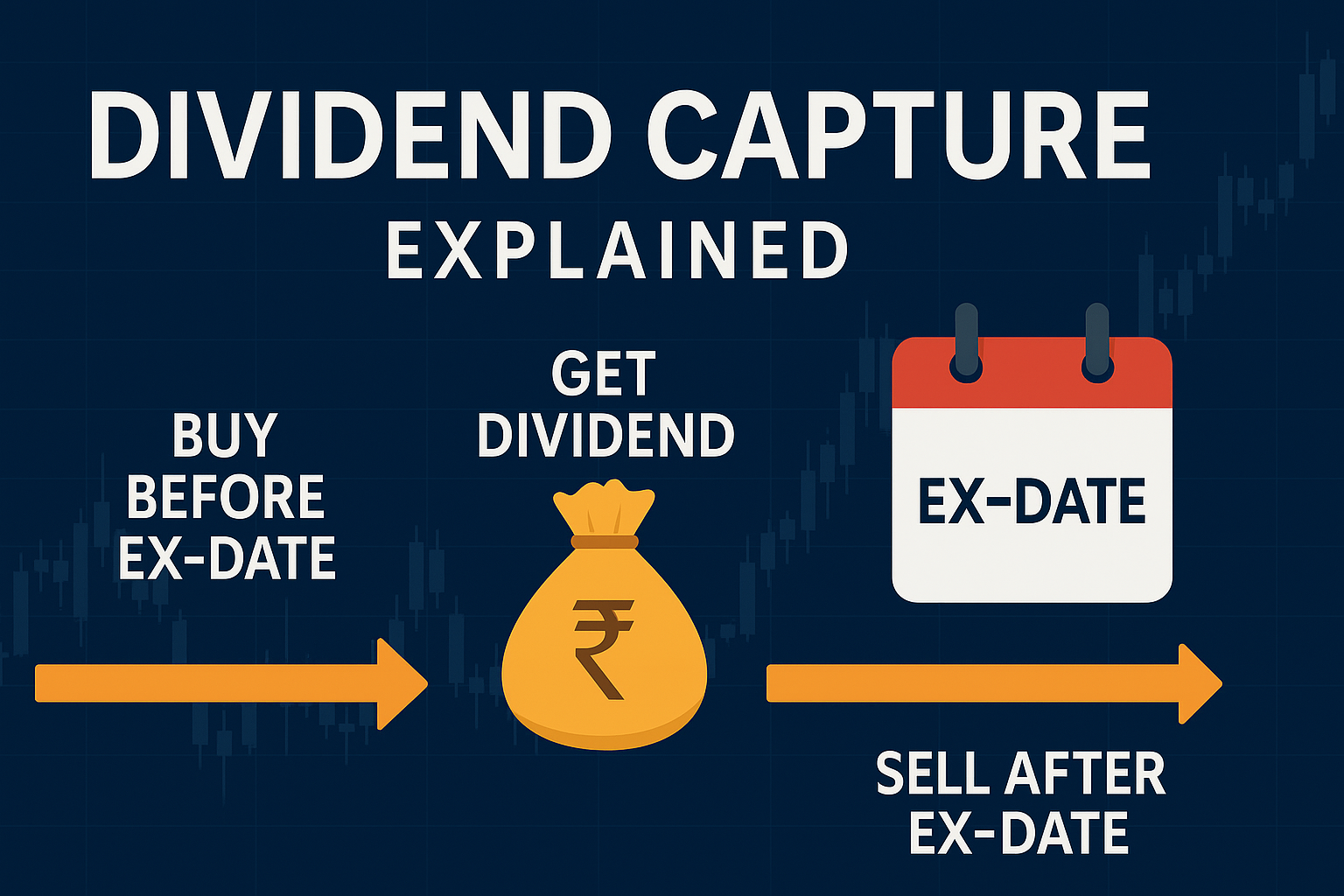
Dividend Capture Date refers to the window during which an investor must purchase a stock to be eligible for its upcoming dividend payout. This is directly tied to the Ex-Dividend Date, which is the most critical date for dividend eligibility. If you buy a stock before the ex-dividend date, you are entitled to receive the dividend—even if you sell the stock shortly after.
Key Dates in Dividend Investing
Date
Meaning
Declaration Date
When the company announces the dividend amount, ex-date, and payment date.
Ex-Dividend Date (Ex-Date)
Buy before this date to receive the dividend. If you buy on or after, you won’t get it.
Record Date
The date on which the company checks its records to identify eligible shareholders (typically one day after ex-date).
Payment Date
The date on which the dividend is actually credited to your bank/brokerage account.
How Does the Dividend Capture Strategy Work?
Here’s how it works:
Buy the stock one day before the ex-dividend date.
Hold it through the ex-dividend date.
Sell the stock on the ex-date or soon after.
Even if you sell the stock right after the ex-dividend date, you will still receive the dividend on the payment date.
Example:
Company: ABC Ltd.
Ex-Dividend Date: 12th July
Dividend Amount: ₹10 per share
Example:
Company: ABC Ltd.
2. Ex-Dividend Date: 12th July
3. Dividend Amount: ₹10 per share
If you buy the stock on 11th July, you are eligible for the ₹10 dividend.
You can sell the stock on or after 12th July and still receive the dividend.
Carch: Why isnt this Free Money?
On the ex-dividend date, the stock price typically drops by approximately the dividend amount. → If the dividend is ₹10, the stock price may open ₹10 lower. This price adjustment balances the dividend payout. Therefore, theoretically, there’s no guaranteed profit.
Risks and Limitations
Price Volatility: The price drop might be more than the dividend, especially in volatile markets.
Taxes: Dividends are taxed in India as per your income slab. Short-term capital gains tax (STCG) may also apply if sold within one year.
Transaction Costs: Brokerage fees, STT (Securities Transaction Tax), and other charges can erode profits.
No Guaranteed Gain: The price may not recover quickly after the ex-date, resulting in potential losses.
Sometimes it works when:
Stocks are illiquid or have slow price adjustments.
There’s market momentum unrelated to dividends.
Traders spot arbitrage or temporary mispricings.
But often, the price drop offsets the dividend gain, especially in liquid, widely-followed stocks.
Should You Try Dividend Capture?
The Dividend Capture Strategy may be suitable for
Advanced traders with expertise in technical analysis.
Those with low transaction costs and quick execution capabilities.
Investors looking for short-term opportunities in specific market conditions.
For most retail investors, long-term dividend investing—focusing on fundamentally strong companies with consistent payouts—is a safer and smarter strategy.