Indian Financial System
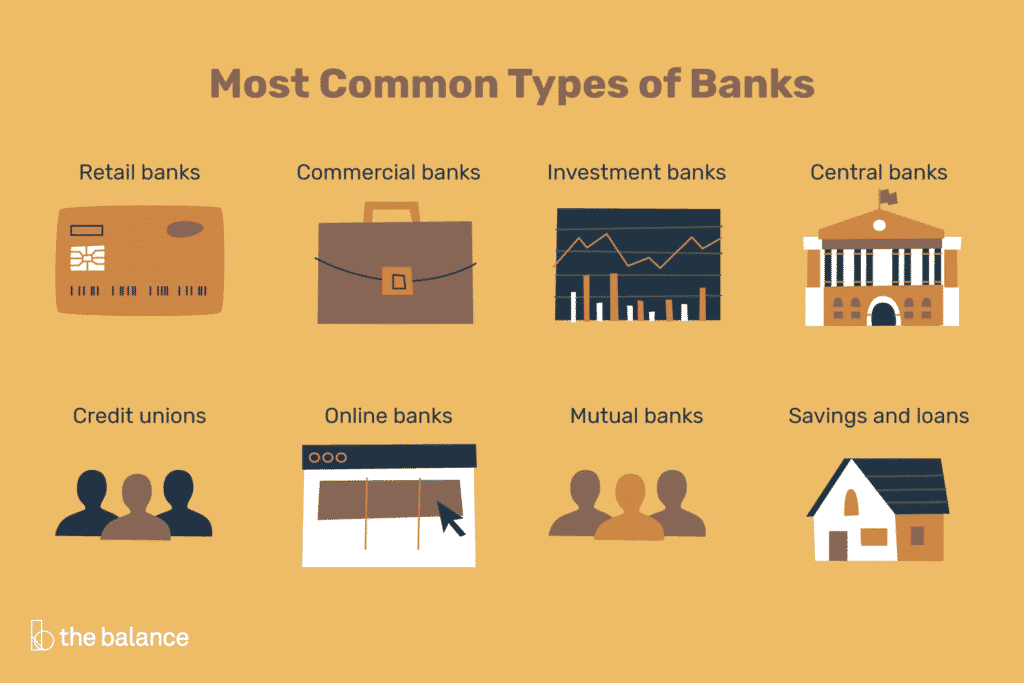
Financial Institutions - Types of Banks
| Type of Bank | Description | Examples |
|---|---|---|
| Commercial Banks | Provide retail and corporate banking services, including loans, deposits, and payment systems. | State Bank of India (SBI), HDFC Bank, ICICI Bank |
| Cooperative Banks | Operate on a cooperative model, serving urban and rural customers, often focusing on small-scale lending. | Saraswat Cooperative Bank, Cosmos Bank |
| Regional Rural Banks (RRBs) | Focus on rural banking, supporting agriculture and small businesses, sponsored by commercial banks. | Assam Gramin Vikash Bank, Kerala Gramin Bank |
| Small Finance Banks | Promote financial inclusion by serving underserved segments with small loans and deposits. | AU Small Finance Bank, Ujjivan Small Finance Bank |
| Payments Banks | Offer digital payment services and small savings accounts, with limited lending capabilities. | Airtel Payments Bank, Paytm Payments Bank |
| Development Banks | Provide long-term financing for industrial and infrastructure projects, often government-backed. | National Bank for Agriculture and Rural Development (NABARD), SIDBI |
Indian Financial System - Overview
- Financial Institutions
- Banking (See table above)
- Non-banking Finance
- Investment
- Insurance
- Pension Fund
- IFSC Units
- Financial Markets
- Capital Market
- Money Market
- Financial Instruments
- Cash Instruments
- Derivative Instruments
- Financial Services
- Asset Based
- Fee Based
- Regulators
- Ministry of Finance
- Ministry of Corporate Affairs
- RBI
- SEBI
- IRDA
- PFRDA
- IFSCA
Indian Financial System - Financial Institutions
Banks
| Type | Description | Examples |
|---|---|---|
| Scheduled Banks | Banks listed in the Second Schedule of the RBI Act, 1934, meeting specific criteria (e.g., minimum capital, public interest). Include commercial banks, cooperative banks, and RRBs. | State Bank of India (SBI), HDFC Bank, Punjab National Bank, Kerala Gramin Bank |
| Non-Scheduled Banks | Banks not meeting RBI’s scheduling criteria, typically smaller cooperative banks with limited operations and no access to RBI’s clearing facilities. | Local cooperative banks (e.g., certain urban cooperative banks not scheduled) |
Non-Banking
| Type | Description | Examples |
|---|---|---|
| Non-Banking Financial Institutions (NBFIs) | Financial institutions not classified as banks but providing services like loans, investments, and leasing, regulated by RBI. | Bajaj Finance, Mahindra Finance, LIC Housing Finance |
| Development Financial Institutions (DFIs) | Specialized institutions providing long-term financing for industrial, agricultural, or infrastructure projects, often government-backed. | National Bank for Agriculture and Rural Development (NABARD), Small Industries Development Bank of India (SIDBI) |
Other Financial Institutions
| Type | Description | Examples |
|---|---|---|
| Investments | Institutions managing investment portfolios, mutual funds, or venture capital, facilitating wealth creation. | UTI Mutual Fund, Aditya Birla Capital, Sequoia Capital India |
| Insurance | Institutions providing risk coverage through life, health, or general insurance products. | LIC of India, ICICI Prudential, Bajaj Allianz |
| Pension Fund | Institutions managing retirement savings through pension schemes, regulated by PFRDA. | National Pension System (NPS), HDFC Pension Fund, SBI Pension Funds |
Indian Financial System - Overview
- Financial Institutions
- Banks (See table above)
- Non-Banking (See table above)
- Investments (See table above)
- Insurance (See table above)
- Pension Fund (See table above)
- IFSC Units
- Financial Markets
- Capital Market
- Money Market
- Financial Instruments
- Cash Instruments
- Derivative Instruments
- Financial Services
- Asset Based
- Fee Based
- Regulators
- Ministry of Finance
- Ministry of Corporate Affairs
- RBI
- SEBI
- IRDA
- PFRDA
- IFSCA
Important Terms:
Scheduled Bank – means a bank included in the Second Schedule of RBI Act’1934. The RBI can direct the inclusion in the Second Schedule of any bank not already so included which carries on the business of banking in India and which has a paid-up capital and reserves of an aggregate value of not less than 5 lakhs of rupees.
Indian Financial System - Scheduled vs. Non-Scheduled Banks (2025)
Basis for Comparison
| Basis | Scheduled Banks | Non-Scheduled Banks |
|---|---|---|
| Meaning | Scheduled bank is a banking corporation whose minimum paid-up capital is Rs. 5 lakhs and does not harm the interest of the depositors. | Non-scheduled banks are the banks which do not comply with the rules specified by the Reserve Bank of India, or say the banks which do not come under the category of scheduled banks. |
| Second Schedule | Listed in the second schedule of the RBI Act, 1934. | Not listed in the second schedule. |
| Cash Reserve Ratio | Maintained with RBI. | Maintained with itself, or by way of balance in a current account with the Reserve Bank or, the state concerned or, with the central co-operative bank of the district concerned. |
| Borrowing | Scheduled banks are allowed to borrow money from RBI for regular banking purposes. | Non-Scheduled banks are not allowed to borrow money from RBI for regular banking purposes. |
| Returns | To be submitted periodically to RBI. | No such provision of submitting periodic returns. |
| Remittance | Scheduled banks get remittances through the offices of the Reserve Bank of India and its agents, for free or at concessional rates. | No such facility is provided. |
Types of Scheduled Banks
- Commercial Banks
- Public Sector Bank (e.g., State Bank of India, Punjab National Bank)
- Private Sector Bank (e.g., HDFC Bank, ICICI Bank)
- Foreign Bank (e.g., Citibank, HSBC)
- Regional Rural Bank (e.g., Kerala Gramin Bank, Assam Gramin Vikash Bank)
- Payments Bank (e.g., Airtel Payments Bank, Paytm Payments Bank)
- Small Finance Bank (e.g., AU Small Finance Bank, Ujjivan Small Finance Bank)
- Local Area Bank (e.g., Coastal Local Area Bank)
- Cooperative Banks
- Urban Cooperative (e.g., Saraswat Cooperative Bank)
- Rural Cooperative (e.g., District Central Cooperative Banks)
Non-Scheduled Banks: Typically smaller cooperative banks not meeting RBI’s scheduling criteria (e.g., certain local urban cooperative banks).
Indian Financial System - Overview
- Financial Institutions
- Banks (Scheduled and Non-Scheduled, see above)
- Non-Banking
- Non-Banking Financial Institutions (e.g., Bajaj Finance)
- Development Financial Institutions (e.g., NABARD, SIDBI)
- Investments (e.g., UTI Mutual Fund)
- Insurance (e.g., LIC of India)
- Pension Fund (e.g., National Pension System)
- IFSC Units (e.g., GIFT City)
- Financial Markets
- Capital Market
- Money Market
- Financial Instruments
- Cash Instruments
- Derivative Instruments
- Financial Services
- Asset Based
- Fee Based
- Regulators
- Ministry of Finance
- Ministry of Corporate Affairs
- RBI
- SEBI
- IRDA
- PFRDA
- IFSCA
Commercial Banks refer to both scheduled and non-scheduled commercial banks which are regulated
under Banking Regulation Act, 1949.
Indian Financial System - Commercial Banks (2025)
Types of Commercial Banks
| Type | Description | Examples |
|---|---|---|
| Public Sector Bank | Government-owned banks providing retail and corporate banking services, focusing on financial inclusion and public welfare. | State Bank of India (SBI), Punjab National Bank, Bank of Baroda |
| Private Sector Bank | Privately-owned banks offering competitive banking services, often with advanced technology and customer focus. | HDFC Bank, ICICI Bank, Axis Bank |
| Foreign Bank | Banks headquartered abroad, operating in India with a focus on corporate and international banking. | Citibank, HSBC, Standard Chartered Bank |
| Regional Rural Bank | Banks sponsored by commercial banks, focusing on rural areas, agriculture, and small businesses. | Kerala Gramin Bank, Assam Gramin Vikash Bank |
| Payments Bank | Banks offering digital payment services and small savings accounts, with limited lending capabilities, promoting financial inclusion. | Airtel Payments Bank, Paytm Payments Bank |
| Small Finance Bank | Banks serving underserved segments with small loans and deposits, emphasizing financial inclusion. | AU Small Finance Bank, Ujjivan Small Finance Bank |
| Local Area Bank | Small-scale banks operating in specific regions, providing localized banking services. | Coastal Local Area Bank, Krishna Bhima Samruddhi Local Area Bank |
Indian Financial System - Overview
- Financial Institutions
- Banks
- Scheduled Banks
- Commercial Banks (See table above)
- Cooperative Banks (e.g., Saraswat Cooperative Bank, District Central Cooperative Banks)
- Non-Scheduled Banks (e.g., certain local cooperative banks)
- Scheduled Banks
- Non-Banking
- Non-Banking Financial Institutions (e.g., Bajaj Finance, LIC Housing Finance)
- Development Financial Institutions (e.g., NABARD, SIDBI)
- Investments (e.g., UTI Mutual Fund, Aditya Birla Capital)
- Insurance (e.g., LIC of India, ICICI Prudential)
- Pension Fund (e.g., National Pension System, HDFC Pension Fund)
- IFSC Units (e.g., GIFT City)
- Banks
- Financial Markets
- Capital Market
- Money Market
- Financial Instruments
- Cash Instruments
- Derivative Instruments
- Financial Services
- Asset Based
- Fee Based
- Regulators
- Ministry of Finance
- Ministry of Corporate Affairs
- RBI
- SEBI
- IRDA
- PFRDA
- IFSCA
Public Sector Bank – Public sector banks are those in which the government holds more than 50% of the total stock. The public sector banks operate under the government to inspire trust in the depositors that their money is safe.
Private Section Bank – Private Sector Banks means banks licensed to operate in India under Banking Commercial Banks
Foreign Bank – Foreign banks are defined as banks from a foreign country working in India through branches. RBI has provided rules and guidelines for a foreign bank to establish and operate in India.
Regional Rural Banks – Regional Rural Banks are government owned scheduled commercial banks of India that operate at regional level in different states of India. These banks are under the ownership of Ministry of Finance, Government of India. They were created to serve rural areas with basic banking and financial services.
Mission of RRBs is to fulfil the credit needs of the relatively un-served sections in the rural areas, small and marginal farmers, agricultural labourers and socio-economically weaker sections.
Shareholding pattern of RRBs among the three sponsoring entities is 50: 35: 15 among the central government, sponsoring bank and state government, respectively.
Under Section 35 (6) of the Banking Regulation Act, the National Bank for Agricultural and Rural Development (NABARD) has been given authority to inspect regional rural banks, State and Central Cooperative Banks.
Payments banks – Payments banks offer remittance services, mobile payments/transfers/purchases and other banking services like ATM/debit cards, net banking and third party fund transfers but can’t advance loans or issue credit cards. These banks can accept a restricted deposit, which is currently limited to ₹200,000 per customer and may be increased further.
Small finance bank shall primarily undertake basic banking activities of acceptance of deposits and lending to un-served and underserved sections including small business units, small and marginal farmers, micro and small industries and unorganised sector. The “small” in SFBs refer to the importance given to the objective of serving the section that is excluded and not the size of bank. At least 50 per cent of their loan portfolio should comprise loans of up-to ₹25 lakh.
Local Area Bank performs banking functions in limited area of two or three contiguous districts. This would enable the mobilisation of rural savings by local institutions and, at the same time, make them available for investments in the local areas.
Note – Differentiated banks are banking institutions that are licensed by RBI to provide specific banking services and products. Differentiated banks are distinct from universal banks as they function in a niche segment. One of the major objectives to create differentiated banks is to promote financial inclusion and payments.
Indian Financial System - Co-operative Banks (2025)
Types of Co-operative Banks
| Category | Type | Description | Examples |
|---|---|---|---|
| Urban Co-operative | Scheduled Co-operative Banks | Urban co-operative banks listed in the Second Schedule of the RBI Act, 1934, meeting criteria like minimum capital, offering retail banking services in urban areas. | Saraswat Co-operative Bank, Cosmos Co-operative Bank |
| Non-Scheduled Co-operative Banks | Urban co-operative banks not meeting RBI’s scheduling criteria, typically smaller with limited operations. | Local urban co-operative banks (e.g., certain city-specific banks) | |
| Rural Co-operative (Short-Term) | State Co-operative Banks | Apex co-operative banks at the state level, providing short-term agricultural and rural loans, and supporting lower-tier co-operatives. | Maharashtra State Co-operative Bank, Gujarat State Co-operative Bank |
| District Central Co-operative Banks | Operate at the district level, financing rural activities and supporting Primary Agriculture Credit Societies. | Mumbai District Central Co-operative Bank, Thane District Central Co-operative Bank | |
| Primary Agriculture Credit Societies | Grassroots-level societies providing short-term credit to farmers for agricultural needs, often affiliated with district banks. | Village-level PACS (e.g., local societies in rural Maharashtra) | |
| Rural Co-operative (Long-Term) | State Co-operative Agriculture and Rural Development Banks (SCARDBs) | State-level banks providing long-term loans for agriculture, rural development, and infrastructure projects. | Kerala State Co-operative Agricultural and Rural Development Bank |
| Primary Co-operative Agriculture and Rural Development Banks (PCARDBs) | Lower-tier banks offering long-term credit for rural and agricultural development, affiliated with SCARDBs. | Local PCARDBs in states like Tamil Nadu, Karnataka |
Indian Financial System - Overview
- Financial Institutions
- Banks
- Scheduled Banks
- Commercial Banks (e.g., SBI, HDFC Bank, Citibank, Kerala Gramin Bank, Airtel Payments Bank, AU Small Finance Bank, Coastal Local Area Bank)
- Co-operative Banks (See table above)
- Non-Scheduled Banks (e.g., certain local co-operative banks)
- Scheduled Banks
- Non-Banking
- Non-Banking Financial Institutions (e.g., Bajaj Finance, LIC Housing Finance)
- Development Financial Institutions (e.g., NABARD, SIDBI)
- Investments (e.g., UTI Mutual Fund, Aditya Birla Capital)
- Insurance (e.g., LIC of India, ICICI Prudential)
- Pension Fund (e.g., National Pension System, HDFC Pension Fund)
- IFSC Units (e.g., GIFT City)
- Banks
- Financial Markets
- Capital Market
- Money Market
- Financial Instruments
- Cash Instruments
- Derivative Instruments
- Financial Services
- Asset Based
- Fee Based
- Regulators
- Ministry of Finance
- Ministry of Corporate Affairs
- RBI
- SEBI
- IRDA
- PFRDA
- IFSCA
Co-operative Bank is a small-sized, financial entity, where its members are the owners and customers of the Bank. Co-operative Bank are primarily registered as cooperative societies under the provisions of either the State Cooperative Societies Act of the State concerned or the Multi State Cooperative Societies Act, 2002 if the area of operation of the bank extends beyond the boundaries of one state.. These Banks have been opened with the motto of ‘no-profit-no-loss’ and thus, do not seek for profitable ventures and customers only. As the name suggests, the main objective of Co-operative Banks is mutual help.
They work on the principle of ‘one person, one vote’. Since these banks are owned by the members, a Board of Directors is chosen democratically and then they are responsible for controlling the Organisation
- • Farmers can avail agricultural loans on minimum interest rates from the Co-operative Banks
- • Providing easy and accessible loans and credit benefits in the rural areas with scarce banking facilities
Urban Co-operative Banks
UCBs are organised with the objective of promoting thrift and self-help among the middle class/lower middle class population and providing credit facilities to the people with small means in the urban/semi- urban centres
The UCBs were under dual regulation by the state registrar of societies and the RBI. But in 2020, all UCBs and multi-state cooperatives banks were brought under the supervision of RBI.
Rural Co-operative Banks
The rural co-operative credit system in India is primarily mandated to ensure flow of credit to the agriculture sector. It comprises short-term and long-term co-operative credit structures.
Short-term co-operative credit structure (STCC)
The STCCS, comprises-
1. Primary agricultural credit societies (PACS) primary agricultural credit society” means a co-operative society, the primary object or principal business of which is to provide financial accommodation to its. members for agricultural purposes or for purposes connected with agricultural activities. Credit from the SCBs is transferred to the District Central Cooperative Banks (DCCBs), that operate at the district level.
The DCCBs work with PACS, which deal directly with farmers.
2. District Central co-operative banks (DCCBs) at the intermediate level, means the principal co-operative society in a district in a State, the primary object of which is the financing of other co-operative societies in that district.
3. State co-operative banks (StCBs) “State co-operative bank” means the principal co-operative society in a State, the primary object of which is the financing of other co-operative societies in the State.
StCBs/DCCBs are registered under the provisions of the state’s State Cooperative Societies Act and are regulated by the Reserve Bank.
Under Section 35 (6) of the Banking Regulation Act, the National Bank for Agricultural and Rural Development (NABARD) has been given authority to inspect regional rural banks, State and Central Cooperative Banks.
Long-term co-operative credit structure (LTCCS)
The LTCCS, comprises
1. Primary co-operative agriculture and rural development banks (PCARDBs) at the district or block level,
2. State co-operative agriculture and rural development banks (SCARDBs) at the State level, has been providing typically medium and long-term loans to provide funding for investment in agriculture, including land development, farm mechanisation and minor irrigation, rural industries and housing.
Section 3 of The Banking regulation Act’1949,
- Notwithstanding anything contained in the National Bank for Agriculture and Rural Development Act, 1981 (61 of 1981), this Act shall not apply to—
- a) a primary agricultural credit society; or
- b) a co-operative society whose primary object and principal business is providing of long-term finance for agricultural development,
- if such society does not use as part of its name, or in connection with its business, the words “bank”, “banker” or “banking” and does not act as drawee of cheques.